
HeyGen built its name on AI avatars. So why are 720 people a month searching for alternatives?
HeyGen crossed 85,000 paying customers in 2025 and helped mainstream the AI avatar video category. With 230+ stock avatars, real-time video translation, and Avatar IV's improved lip-sync, the platform earned its spot as a go-to for teams that need a talking head without a camera.
But across Reddit, G2, and Trustpilot, a pattern keeps surfacing: HeyGen's credit system charges you for every re-render, not just the final export. Test four versions of a script, burn four credits. One Trustpilot user described the process as "an endless cycle of payments," and community forums confirm that credits get consumed during editing, not just on final renders. With "heygen pricing" pulling 2,400 searches a month (up 50% from mid-2025), the frustration is measurable.
We tested 7 HeyGen alternatives across AI capabilities, avatar quality, pricing transparency, and real user sentiment from G2, Capterra, and Reddit. Here's what held up.
Where HeyGen falls short in 2026
HeyGen is a capable platform, but these pain points keep driving teams to look elsewhere.
Credit-based pricing that punishes iteration. Avatar IV videos consume 20 premium credits per minute. HeyGen's Creator plan includes 200 credits, which covers only 10 minutes of premium avatar video per month. Every re-render costs the full credit amount again, so teams iterating on scripts burn through allocations fast. Community sentiment across review aggregators leans 46% negative on pricing (per CheckThat.ai's analysis of HeyGen reviews), primarily around credit limits that feel opaque.
"Unlimited" plans with hidden caps. The word "unlimited" appears in HeyGen's marketing, but premium credit limits are not published per plan, and unused credits don't carry over. Teams who max out Avatar IV or translation in the first week of a billing cycle feel the product is expensive.
Avatar expressiveness gaps. Reddit users report limited facial expressions and repetitive gestures that reduce emotional impact, especially for customer-facing or trust-based content. Lip-sync accuracy can feel robotic in some renders.
Support leans on bots. The first response to support tickets is often a generic knowledge base link. Resolution times run long, especially for refund or billing disputes.
Quick comparison
| Tool | Best For | Starting Price | Key Differentiator |
|---|---|---|---|
| ngram | Professional video from any asset | Free / $29/mo | AI-powered, context-aware generation |
| Synthesia | Enterprise L&D and training | Free / $18/mo | 240+ avatars, 140+ languages |
| D-ID | Photo-to-video animation | $4.70/mo | Creative Reality Studio API |
| Colossyan | Corporate training with SCORM | Free / $27/mo | Branching scenarios, quizzes |
| InVideo AI | Text-to-video with generative AI | Free / $28/mo | Sora 2 + VEO 3.1 built in |
| VEED | Browser-based video editing | Free / $12/mo | Transcript-based editing, AI Copilot |
| Pictory | Blog and text to video | Free trial / $19/mo | URL-to-video conversion |
| DeepBrain AI | Enterprise AI video studios | $30/mo | 150+ avatars, 80+ languages |
1. ngram
If you're reading this because HeyGen's credit system is eating your budget on re-renders, ngram takes a fundamentally different approach. Instead of charging per render, ngram gives you AI-powered video creation that starts from whatever you already have - screen recordings, documents, images, URLs - and turns them into professional, on-brand videos.
What makes ngram stand out
Context-aware generation is the core differentiator. Tell ngram your audience (developers vs. executives), your goal (educate vs. convert), and your channel (LinkedIn vs. website). The output adapts structure, pacing, tone, and visuals automatically. A LinkedIn announcement gets a fast hook and tight pacing; a website explainer takes more time to build context. This level of intent-aware adaptation is rare in the video space.
Plan first, generate second means you review the script and storyboard before anything renders. This is where HeyGen's credit model falls apart - with ngram, you fix direction at the cheapest possible moment instead of burning credits on re-renders.
Start from what you have. Drop in a doc, a deck, screenshots, a rough screen recording, or a URL. ngram extracts what it needs, organizes the content, and builds a coherent video. No blank-page problem.
AI-powered editing turns rough screen recordings into polished walkthroughs with automatic filler word removal, smart zoom on interactions, cursor emphasis, and callouts driven by your prompts.
Key features
- Context-aware generation - Adapts structure, pacing, and tone to your audience and channel
- Plan first, generate second - Script and storyboard review before rendering
- Any asset in - Text, images, docs, URLs, screen recordings as input
- AI editing - Auto-cut, filler removal, smart zoom, cursor emphasis
- Multi-format export - 16:9, 9:16, 1:1 with captions included
- Brand kits - Logo, colors, fonts applied automatically to every video
Pros
- ✅ No credit system - create and iterate without per-render charges
- ✅ Context-aware output adapts to audience, goal, and channel automatically
- ✅ Works with assets you already have (docs, recordings, URLs)
Cons
- ❌ Web-based only - no native desktop app yet
- ❌ No AI avatars (different approach: real footage and motion graphics)
Who is ngram best for?
Product Marketing, Growth, Sales Enablement, Customer Success, and Agencies who need professional videos without production timelines or per-render credit anxiety. If your videos go to customers, prospects, or public audiences, ngram is the pick.
ngram has a generous free plan with paid plans starting at $29 per month.
Ready to try ngram? Create your first video in under 5 minutes. Start free
See ngram in action:
2. Synthesia

Synthesia is the closest direct competitor to HeyGen in the AI avatar space. With 240+ AI avatars, support for 140+ languages, and over 1,600 G2 reviews, it's the platform most enterprise L&D teams evaluate first when moving off HeyGen.
Synthesia recently dropped prices by 38% and introduced AI Playground with access to Veo 3.1 and Sora 2 for generating video assets across all plan tiers.
Key features
- 240+ AI avatars - Larger avatar library than HeyGen's 230+
- 140+ languages - Industry-leading multilingual support
- AI Playground - Access to Veo 3.1 and Sora 2 for asset generation
- Studio Express avatars - Custom avatar creation from video
- SCORM export - Direct LMS integration for training teams
What users say
G2 reviewers consistently praise Synthesia for enterprise-grade collaboration features and the breadth of its avatar library. Reddit users note the avatars are more expressive than HeyGen's, though some flag the $1,000/year add-on for Studio Express-1 avatars as steep. For teams producing high volumes of multilingual training content, the language coverage is the main draw over HeyGen.
Pros
- ✅ Largest avatar library with more natural expressions than HeyGen
- ✅ 140+ languages make it the multilingual leader
- ✅ Recent 38% price drop makes it more accessible
Cons
- ❌ Studio Express avatars cost $1,000/year extra
- ❌ Enterprise features locked behind custom pricing
Best for
Enterprise L&D teams and marketing departments producing large volumes of AI avatar videos, especially multilingual content. Pricing starts at $18/month (Starter) with a free Basic plan.
For a detailed head-to-head, see our ngram vs Synthesia comparison.
3. D-ID
D-ID takes a different approach from HeyGen: rather than offering a full video studio, it specializes in turning still photos into talking avatars using its Creative Reality Studio. The platform is API-first, making it popular with developers building avatar experiences into their own products.
D-ID's technology combines deep-learning face animation with text-to-speech, supporting personalization in 100+ languages.
Key features
- Creative Reality Studio - Photo-to-video avatar animation
- API access - Developer-friendly integration
- 100+ languages - Broad multilingual support
- Voice cloning - Clone voices for consistent brand presence
- Mobile and desktop - Available across platforms
What users say
Developers on Reddit praise D-ID's API for rapid prototyping and integration flexibility. The main complaints center on avatar quality for longer videos - the photo-based animation can feel limited compared to HeyGen's full-body avatars. G2 reviewers note the pricing is competitive for API usage but less so for studio-based creation.
Best for
Developers and product teams building avatar features into their own platforms, and solo creators who want quick photo-to-video output. Pricing starts at $4.70/month (Lite, billed annually).
For a detailed comparison, see ngram vs D-ID.
4. Colossyan
Colossyan positions itself as the AI video platform built for corporate training teams. While HeyGen focuses broadly on marketing and sales content, Colossyan goes deep on L&D with SCORM export, branching scenarios, in-scene quizzes, and LMS integration.
The platform is trusted by Paramount Pictures, Cisco, and Vodafone for employee onboarding and compliance training.
Key features
- 300+ AI avatars - Including side-view conversation avatars
- SCORM export - Direct LMS delivery
- Branching scenarios - Interactive learning paths
- In-scene quizzes - Embedded assessments
- 70+ language translation - One-click video localization
What users say
G2 reviewers highlight Colossyan as the strongest option for teams that need LMS-compatible video content without a production team. Reddit discussions note the avatar expressiveness has improved significantly, though some users wish the free plan included more than 5 minutes of video. For training-focused teams, the branching scenarios and quizzes are features HeyGen doesn't match.
Best for
L&D, HR, and compliance teams producing training videos at scale. The free plan includes 5 minutes; paid plans start at $27/month (Starter).
See our ngram vs Colossyan comparison.
Looking for the fastest way to create professional videos? ngram turns your screen recordings, docs, and images into polished videos in minutes. Try ngram free
5. InVideo AI
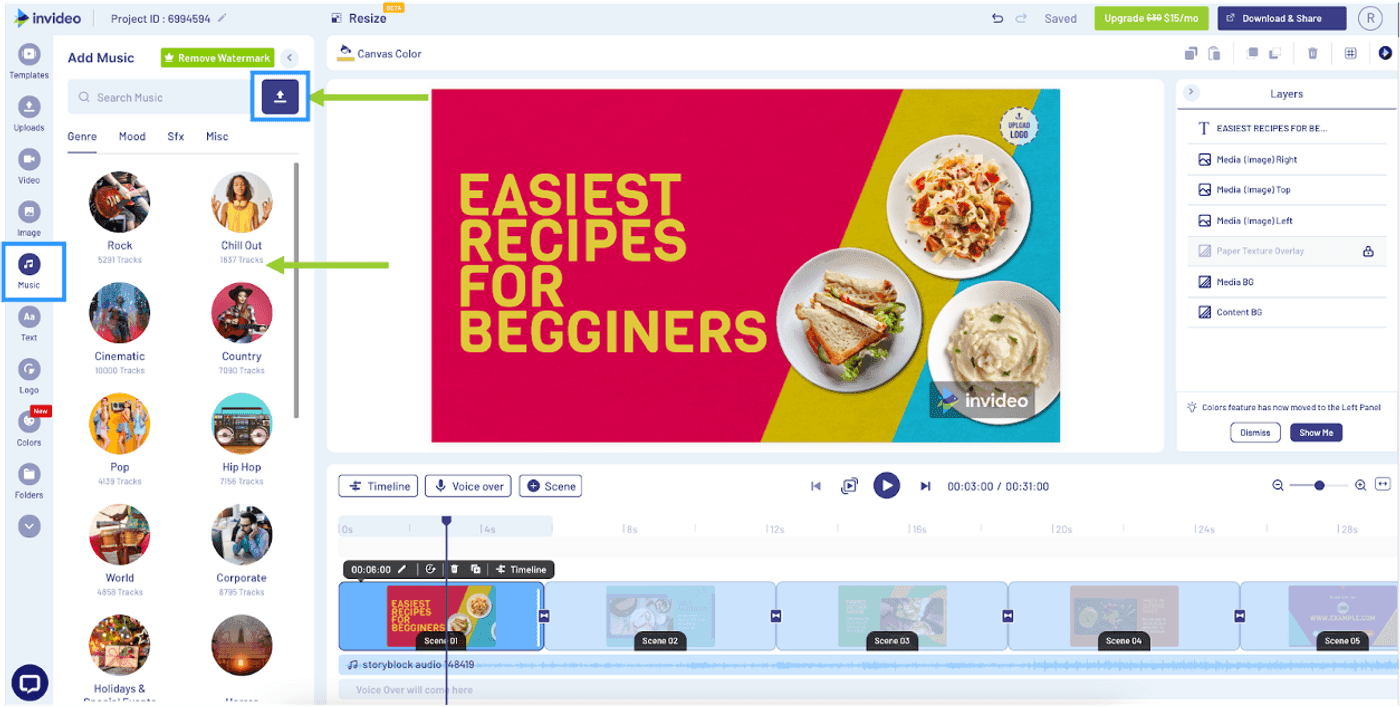
InVideo AI is the text-to-video tool that went all-in on generative AI. The platform now integrates OpenAI's Sora 2 and Google's VEO 3.1 directly into its pipeline, generating cinematic clips alongside stock footage. For teams that want AI-generated video without avatar talking heads, it's a strong HeyGen alternative.
InVideo reports millions of users and recently added voice cloning, e-commerce video tools, and multi-format simultaneous export.
Key features
- Sora 2 + VEO 3.1 integration - Generative AI models built into the pipeline
- Voice cloning - Upload a 30-second sample, get a reusable voice clone
- E-commerce tools - Product photo to Amazon A+ content and ad reels
- Multi-format export - 16:9, 9:16, 1:1 simultaneously
- Brand kit support - Agencies managing multiple clients
What users say
Reddit users praise InVideo's text-to-video speed and the quality bump from Sora 2 integration. The most common complaint is that the free plan includes watermarks and limited AI minutes (~10/week). G2 reviewers note the learning curve is minimal compared to HeyGen, but the generative AI output can sometimes feel inconsistent across longer videos.
Best for
Content creators and marketing teams who want AI-generated video (not avatar-based) from text prompts. Free plan available; Plus starts at $28/month.
See our ngram vs InVideo comparison.
6. VEED
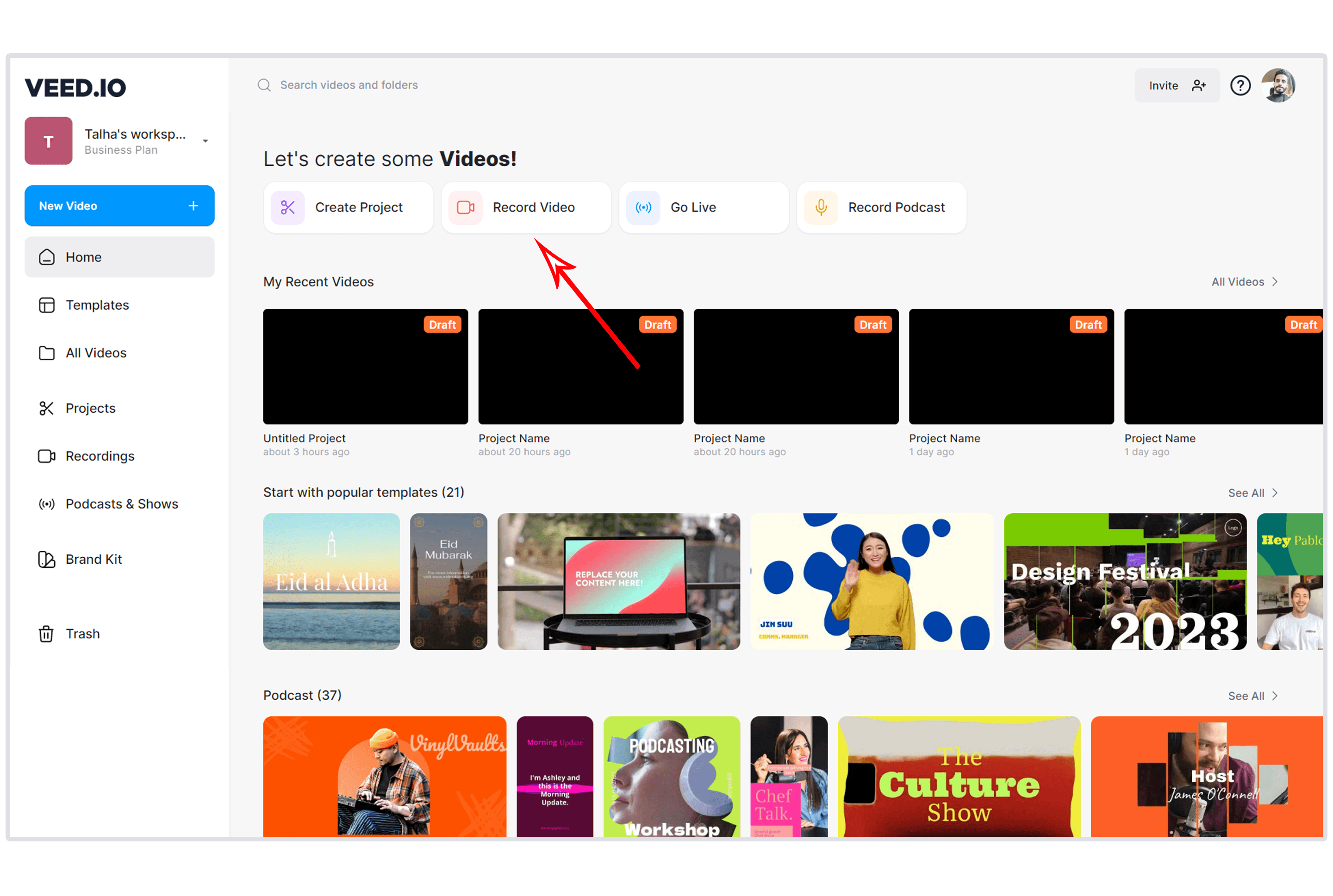
VEED is the browser-based video editor that's evolved into a full AI-powered creation platform. Unlike HeyGen's avatar-first approach, VEED focuses on editing existing footage with AI assistance - auto-subtitles in 125+ languages, filler word removal, eye contact correction, and a new AI Copilot that executes multi-step edits from natural language commands.
VEED has grown into one of the most accessible video editing tools available, with no installation required.
Key features
- AI Copilot - Natural language commands for multi-step edits
- Transcript-based editing - Edit video by editing text
- Auto-subtitles - 125+ languages with translation
- Magic Cut - Automatic filler word and pause removal
- Eye contact correction - AI adjusts gaze to camera
What users say
Reddit users consistently call VEED "the easiest video editor they've used." The browser-based approach eliminates installation friction, and the subtitle accuracy is frequently praised. Complaints center on the free plan's 720p watermarked exports and the Pro plan's $29/month price point for features like background removal. For teams moving from HeyGen who want to edit their own footage rather than use AI avatars, VEED fits.
Best for
Teams editing existing video footage who want browser-based simplicity with AI assistance. Free plan available; Lite starts at $12/month.
See our ngram vs VEED comparison.
7. Pictory
Pictory turns written content into video. Paste in a blog post URL, a script, or a white paper, and Pictory pulls relevant visuals, adds transitions, overlays AI voiceovers, and creates a branded video. For content marketing teams repurposing written content, it's a practical HeyGen alternative that skips the avatar entirely.
Pictory also offers webinar and long-form video summarization, automatically extracting highlight clips.
Key features
- URL-to-video - Turn blog posts into videos automatically
- Script-to-video - Paste text, get a complete video
- Highlight extraction - Pull short clips from webinars and podcasts
- AI voiceover - Generate narration from text
- Brand kit - Colors, fonts, logos applied across videos
What users say
G2 reviewers praise Pictory for content repurposing speed - turning a 2,000-word blog post into a 3-minute video in under 10 minutes. Reddit users note the stock footage matching can be hit-or-miss, and the AI voiceover quality varies. For teams whose primary need is turning existing written content into video rather than creating avatar-based presentations, Pictory delivers at a lower price than HeyGen.
Best for
Content marketing teams repurposing blogs, articles, and long-form content into video. Free trial available; Standard starts at $19/month.
See our ngram vs Pictory comparison.
8. DeepBrain AI
DeepBrain AI (now branded as AI Studios) targets enterprise teams with 150+ AI avatars, 80+ language support, and multi-avatar scenes. The platform reports over 2 million users and counts AWS, BMW, Samsung, and Pfizer among its enterprise clients.
DeepBrain differentiates from HeyGen with its focus on enterprise deployment and the ability to create custom avatars from photos.
Key features
- 150+ AI avatars - Including custom avatar creation
- 80+ languages - Text-to-speech and translation
- Multi-avatar scenes - Multiple presenters in one video
- Enterprise clients - AWS, BMW, Samsung, Pfizer
- Photo-to-avatar - Create an avatar from your own image
What users say
Gartner Peer Insights reviewers note DeepBrain's strength in enterprise deployment and multilingual support. Reddit discussions highlight the avatar quality as competitive with HeyGen, though the $30/month Starter plan lacks the free tier that both HeyGen and Synthesia now offer. The multi-avatar scene capability is a standout feature for teams producing training content with dialogue.
Best for
Enterprise teams producing multilingual avatar videos at scale, especially those needing multi-avatar scenes. Starter plan at $30/month; Pro at $225/month.
See our ngram vs DeepBrain comparison.
Here's how the AI avatar market has grown and where it's heading:
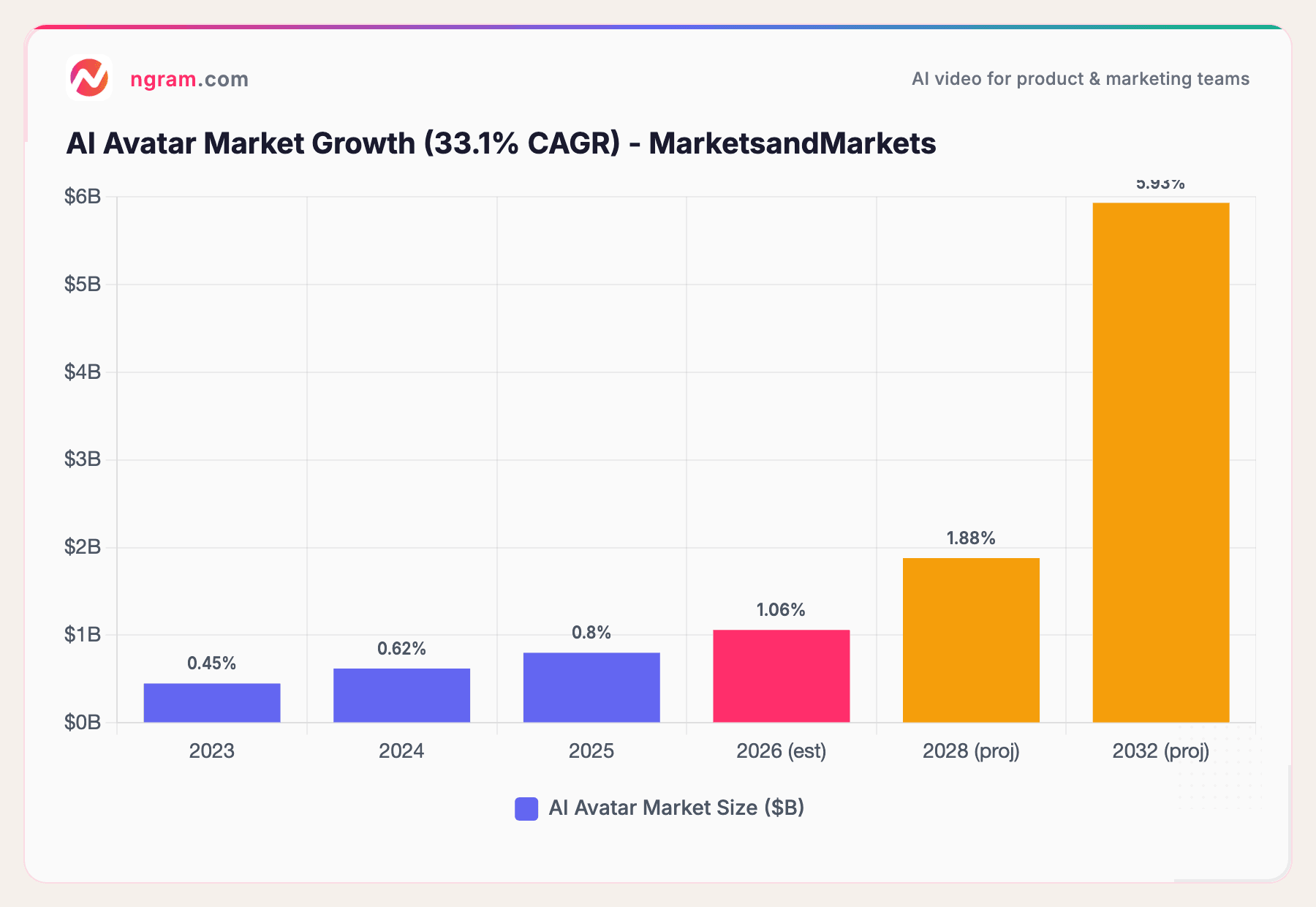
The AI avatar market is projected to grow from $0.80 billion in 2025 to $5.93 billion by 2032, a 33.1% CAGR according to MarketsandMarkets. That growth is driving every tool on this list to iterate faster, which means better options for teams evaluating HeyGen alternatives today.
What we actually tested
We didn't just list tools. We tested them, read hundreds of user reviews across G2 (1,400+ HeyGen reviews alone), Capterra, Reddit, and Product Hunt, and compared them across five weighted criteria:
| Criteria | Weight | What we looked at |
|---|---|---|
| AI Capabilities | 30% | AI generation quality, avatar realism, voice synthesis, generative features |
| Avatar Quality | 30% | Lip-sync accuracy, emotional range, customization, expressiveness |
| Ease of Use | 20% | Onboarding experience, learning curve, UI clarity |
| Value | 15% | Pricing transparency, credit systems, free tier generosity, cost per minute |
| Support & Community | 5% | Documentation, response time, community resources |
We also factored in:
- Real user reviews from G2, Capterra, TrustRadius, Reddit, and Product Hunt (qualitative sentiment, not numerical scores)
- Market presence and company stability (funding, user base, enterprise clients)
- Integration ecosystem with common business tools and LMS platforms
- Industry trends and where the AI avatar market is heading
For the AI video category, we weighted AI Capabilities and Avatar Quality equally at 30% each because these are the two dimensions that differentiate tools in this space most sharply.
Frequently Asked Questions
Is there a free HeyGen alternative?
Yes. Synthesia, InVideo AI, VEED, and Colossyan all offer free plans with limited features. ngram also has a generous free tier. D-ID offers a 14-day trial. The free plans vary in what they include - Synthesia's free Basic gives you 1,200 credits (~10 minutes), while VEED's free tier exports at 720p with a watermark.
How does HeyGen compare to Synthesia in 2026?
Synthesia leads on avatar library size (240+ vs 230+), language support (140+ vs HeyGen's smaller set), and recently dropped prices by 38%. HeyGen's Avatar IV offers slightly better lip-sync in some tests, but the credit-based pricing model frustrates teams who iterate frequently. For enterprise L&D, Synthesia's SCORM export and collaboration features give it an edge.
What's the cheapest HeyGen alternative?
D-ID starts at $4.70/month (Lite plan, billed annually), making it the lowest entry point. VEED's Lite plan at $12/month is the cheapest full editing solution. For free options, ngram, Synthesia, InVideo AI, and VEED all offer functional free tiers.
Can I create videos without AI avatars?
Absolutely. ngram, InVideo AI, VEED, and Pictory all create professional videos without avatar talking heads. ngram generates videos from your existing assets (docs, recordings, URLs), InVideo AI uses generative AI models, VEED focuses on editing existing footage, and Pictory converts written content to video.
Is HeyGen worth the price in 2026?
For teams who stay inside included credits and use HeyGen weekly for avatar-based content, it can be a bargain relative to agency work. But if your video volume is unpredictable, your team iterates frequently, or you need to show your actual product (not a generic talking head), the credit system gets expensive fast. The alternatives on this list offer more transparent pricing models.
What is the best HeyGen alternative for business video?
For business teams that need professional, on-brand video across multiple use cases (not just avatar videos), ngram is the strongest fit. It creates videos from your existing assets, adapts output to your audience and channel, and doesn't charge per render. For avatar-specific needs, Synthesia leads for enterprise L&D and Colossyan for training with interactive elements.
Our verdict
The AI avatar space in 2026 is crowded, and every tool on this list solves a different slice of the video creation problem. If you're a marketing or product team that needs polished, on-brand video from existing assets without per-render credit anxiety, ngram is the strongest fit. If you specifically need AI avatars for enterprise L&D, Synthesia edges out HeyGen on avatar library size and language coverage at a lower price point. And if you just need to edit existing footage with AI assistance, VEED gets the job done for $12/month.
The one team that should probably stay on HeyGen: if you're using Avatar IV daily, staying within credit limits, and the lip-sync quality is working for your use case, the switching cost may not be worth it.
Try ngram free - your first video in under 5 minutes. Skip the avatar, skip the credit math. Turn raw screen recordings, docs, or images into polished, on-brand videos without touching a timeline. Start free