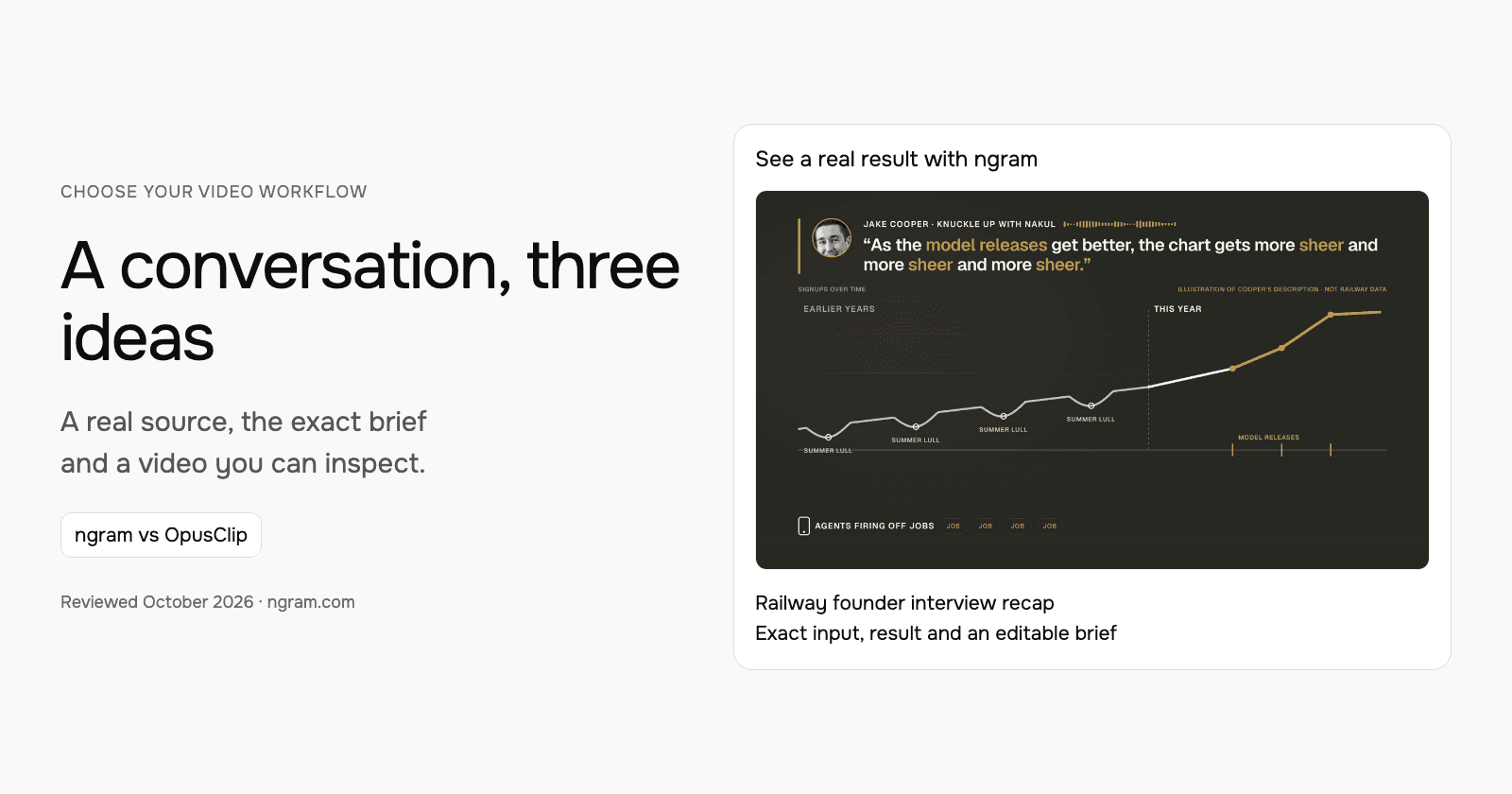

A recap explains the important ideas across a session; a clip preserves a useful moment from it. That distinction is a better starting point than a general ngram-versus-OpusClip ranking. This example shows a Railway founder interview condensed into an attributed recap with actual speaker excerpts.
Decide whether to preserve a moment or connect ideas
The source is Jake Cooper’s conversation with Nakul Mandan. The brief names three takeaways: model releases and signups, recommendations by AI models, and saying no to lower-priority ideas. It explicitly asks for Cooper’s observations to remain attributed instead of treating AI search as proven cause of revenue growth.
| Decision | In this example |
|---|---|
| Source | A public founder interview on Knuckle Up with Nakul. |
| Takeaway one | Cooper’s observation about models and Railway signups. |
| Takeaway two | His team’s work on model recommendations. |
| Takeaway three | Focus and the question of why to pursue an idea now. |
| Next action | Watch the full conversation. |
Watch the actual input become a video
The recap combines narrated transitions with attributed excerpts from Cooper. It connects ideas from the conversation rather than presenting an uninterrupted highlight. The prompt, transcript and full source make those editorial choices visible; the result is a summary of the interview, not independent proof of a growth mechanism.
From this input to this video
Three takeaways from Jake Cooper’s conversation with Nakul Mandan, combining attributed audio clips with animated explanations.
Create a 45-second recap of How Railway says no to 90% of ideas and keeps winning, Jake Cooper’s conversation with Nakul Mandan on Knuckle Up with Nakul for founders and product teams thinking about AI-driven growth. Use this recording or transcript as the source: https://www.youtube.com/watch?v=LQNqM1mA2e8. Focus on these takeaways: Jake Cooper says stronger AI model releases coincide with sharper Railway signup growth as people run more agent-created work; he describes his go-to-market team working to get models to recommend Railway and use its infrastructure; he explains that the team rejects most ideas to stay focused on the work it judges most valuable. Present these as Cooper’s observations and approach, not proof that AI search alone caused revenue growth. Explain each takeaway with the example or evidence the speaker actually provided. Preserve the meaning of quotations and attribute named speakers accurately. Use supplied session visuals when relevant; use clearly labeled motion graphics for concepts. Close with Watch the full conversation on Knuckle Up with Nakul. Format for LinkedIn in landscape 16:9. Tone: clear and thoughtful. Voiceover language: English.
Read the exact input
Prompt
Create a 45-second recap of How Railway says no to 90% of ideas and keeps winning, Jake Cooper’s conversation with Nakul Mandan on Knuckle Up with Nakul for founders and product teams thinking about AI-driven growth. Use this recording or transcript as the source: https://www.youtube.com/watch?v=LQNqM1mA2e8. Focus on these takeaways: Jake Cooper says stronger AI model releases coincide with sharper Railway signup growth as people run more agent-created work; he describes his go-to-market team working to get models to recommend Railway and use its infrastructure; he explains that the team rejects most ideas to stay focused on the work it judges most valuable. Present these as Cooper’s observations and approach, not proof that AI search alone caused revenue growth. Explain each takeaway with the example or evidence the speaker actually provided. Preserve the meaning of quotations and attribute named speakers accurately. Use supplied session visuals when relevant; use clearly labeled motion graphics for concepts. Close with Watch the full conversation on Knuckle Up with Nakul. Format for LinkedIn in landscape 16:9. Tone: clear and thoughtful. Voiceover language: English.
Selected style
Kinetic type
Source material
Read the video transcript
Railway's Jake Cooper, on Knuckle Up with Nakul: three lessons for growth in the AI era. One. Cooper says Railway's signups used to dip every summer. This year they kept climbing, as people run agents that fire off jobs from their phones. Jake Cooper: As the model releases get better, the chart gets more sheer and more sheer and more sheer. Two. His go-to-market team is courting a new audience: the models themselves. Jake Cooper: On the go-to-market side, we're figuring out how to incept the models to recommend us more and more and more. And teaching them to put their hands on Railway's infrastructure. Three. Railway says no to about ninety percent of ideas, from conferences to AI work until around 2023. Every proposal ends with one question: why now? Jake Cooper: We say no, we say no, we say no. And then when it's inevitable, we say yes. Watch the full conversation on Knuckle Up with Nakul.
Turn a conversation into a useful recap
Watch the real ngram recap of the Railway founder interview. Read its actual source and prompt, then adapt the brief for your own session.
Bring the session
Use your authorized episode or public interview source. If reusing an edited export from OpusClip, upload the video file to ngram and keep the original project in its source tool.
Shape the recap
Fill in the session, audience and next step. Select a style, duration and aspect ratio, then attach your source and choose your Brand Kit in ngram.
Approve and refine
Approve the plan containing the script. Review the generated recap for accurate quotations and attribution, then request revisions before sharing.
Make it yours
Fill in your details here, or continue and finish your brief in ngram.
Where each workflow fits
OpusClip offers clipping workflows for finding and adapting moments from longer recordings. Its separate Agent Opus also creates videos with a review workflow. Compare the appropriate product: evaluating clipping alone does not describe everything the company now offers.
Choose a clip when a speaker’s full moment is what the audience needs. Choose a new ngram recap when several ideas need a connecting explanation and a reusable brief. If considering Agent Opus for that same recap, compare its review path, usage allowance and revisions separately from the clipping subscription.
Prepare your own version
Provide the authorized recording or a suitable public source, the intended audience, takeaways and next action. Separate a speaker’s claim from your interpretation. Ask for quotations to preserve meaning and for named speakers to be attributed correctly, as the actual brief below does.
Use the editable brief above to fill in your own source and details. Choose the style, length and aspect ratio. In ngram, attach your files, select your configured Brand Kit and enable captions when wanted. Approve the plan containing the script, then inspect the video and request revisions through chat or the timeline.
Make the next update useful
For a different audience, ask ngram to change which takeaways receive emphasis and explain why. Keep the same source evidence for any quotation that remains. Request another aspect ratio and length as a new version; retain a downloaded copy when both versions need stable publication.
Budget and delivery
ngram Free includes 1,000 credits/month and supports public sharing and embeds. Premium AI video generation uses 10 credits per second; a cheaper model uses 3 credits per second. At the premium rate, a 30-second generation uses 300 credits. Check the chosen model and available credits before creating your version.
Use a paid plan to download an MP4. Unlisted video links start with Basic. Compare the other product’s current billing term, seats and usage unit against your complete job, including the revisions and publishing method you need. See ngram pricing and the full comparison for the broader buying decision.
Frequently asked questions
Is the example a webinar recording?
The template is reusable for sessions and webinars; this actual example is a public founder interview. Its source and context are labeled accordingly.
Does the interview prove AI search caused Railway’s growth?
The recap attributes the observations and approach to Cooper. Use the conversation as a source for what he said, rather than as a controlled attribution study.
Continue with your own material
Start with the editable template, explore source-to-video workflows, or talk to sales about a team workflow.
Sources and scope
Product information reviewed October 18, 2026. The embedded result was created with ngram from the exact input shown. Competitor descriptions use official sources; this article does not claim a timed or scored test of competing outputs.
Agent Opus creation and review